Description

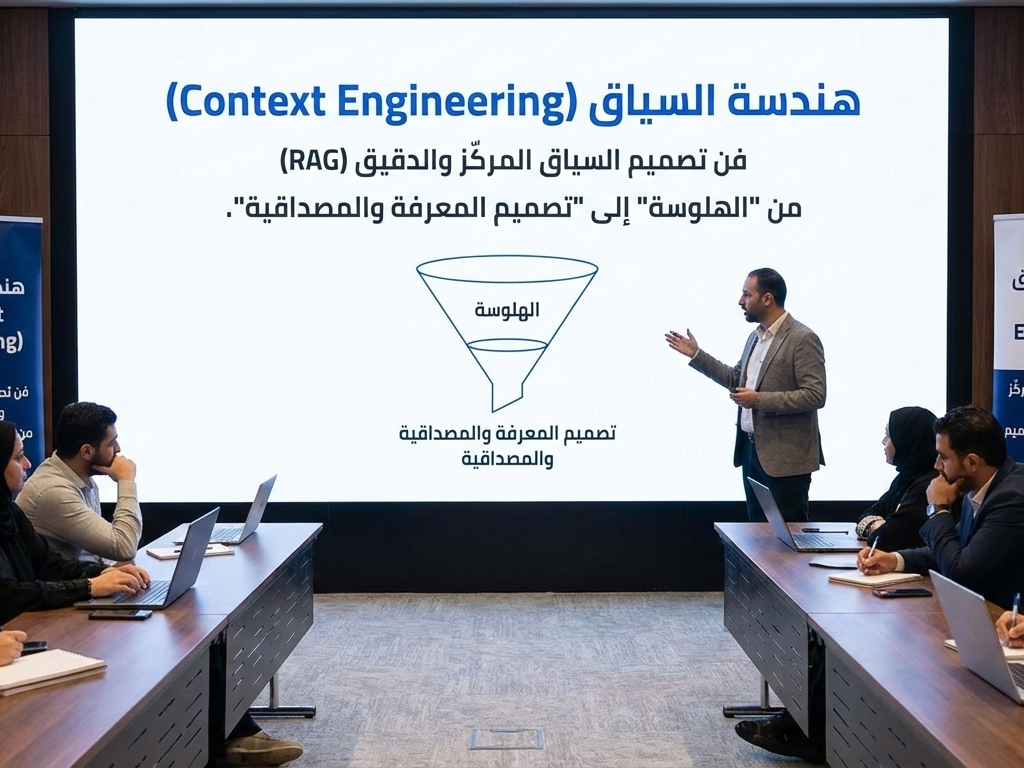
This course is designed to be your practical gateway to understanding Context Engineering, the next essential skill in the world of artificial intelligence.

What problem are we solving?

Current AI tools (such as ChatGPT) are powerful, but their knowledge is general-purpose and limited to a specific point in time. They have no awareness of your company’s internal files, private documents, or the latest updates on your website.

What solution does this course offer?

In addition to the important role of Prompt Engineering—the art of crafting the perfect question—you will learn Context Engineering. This means designing the complete informational environment in which AI operates. It is a crucial integration within the broader skill set of working with artificial intelligence.

How will we do this?

We will focus on the most important technique in this field: Retrieval-Augmented Generation (RAG). Simply put, you will learn how to create a knowledge base or a custom “brain” from your own documents (such as PDF files), and train the AI to search this knowledge base first before answering any question.

What else will you learn?

We will go beyond the basics. You will learn how to improve answer accuracy, handle ambiguous questions, and explore how simple intelligent systems can self-correct when they fail to find the correct answer on the first attempt.

Who is this course for?

This course is designed for beginners. No advanced programming or AI experience is required. All you need is curiosity and a desire to make AI work for you—using your own data.

Acquired Skills

By the end of this course, participants will be able to:

  1. Clearly explain what “context” means in artificial intelligence and why it is more important than simply writing a good prompt.
  2. Understand the core limitation of AI memory (the context window) and why we cannot simply “feed” it an entire book and expect it to remember everything.
  3. Prepare documents such as PDFs to build a knowledge base that AI systems can search through.
  4. Apply the fundamental principles of Retrieval-Augmented Generation (RAG) to build a simple question-and-answer system.
  5. Improve the quality of AI responses using simple techniques to filter out poor results.
  6. Identify solutions to common challenges, such as how AI handles ambiguous or complex questions.
  7. Describe the simplified concept of intelligent systems that can make basic decisions, such as searching again if the first result is unsatisfactory.
  8. Evaluate the faithfulness of an AI assistant to its source materials, ensuring it does not fabricate answers (reducing hallucinations).

Target Group

This course is designed for anyone curious about how AI works behind the scenes and who wants to harness its power for customized tasks. The target audience includes:

  • Small business owners and entrepreneurs: Those who want to build a simple AI assistant that answers customer questions based on a product catalog or an FAQ page.
  • Content creators and marketers: Professionals who want to ensure AI-generated content consistently adheres to their brand voice or is grounded in specific product or business information.
  • Teachers and trainers: Individuals interested in creating intelligent educational tools that answer students’ questions based on a specific curriculum or set of textbooks.
  • Developers and programmers (beginners): Those who have heard of RAG and want a foundational understanding of how information retrieval systems work.
  • Students and researchers: Anyone looking to build a personal assistant to help summarize and search within their digital library of research papers and books.
  • Advanced users of AI tools: Users who feel they’ve reached the limits of prompt writing and want to understand the next level of control over AI systems.

Notes

Dr. Osayd sulayman Fatayer - Born in Nablus, Palestine

  • Holds a PhD in Economics and Islamic Banking from Yarmouk University, Jordan.
  • University lecturer / Assistant Professor at the College of Sharia, An-Najah National University, since 27/8/2018 to present.
  • Certified Financial Dispute Arbitrator by the Palestinian Ministry of Justice, and a certified Islamic Arbitrator and Expert (CIAE) by the International Islamic Centre for Reconciliation and Arbitration. He has also served as an arbitrator for several peer-reviewed academic journals specializing in Islamic economics and finance.
  • Member of the preparatory committees for a number of academic conferences in Sharia and Islamic jurisprudence.
  • Producer and presenter of television programs on several Arab and Islamic satellite channels.
  • Expert in artificial intelligence tools and their applications in education and scientific research.
  • Continuously up to date with the latest AI technologies and methods for integrating them into educational and research contexts.
  • Designer and presenter of numerous training courses and workshops in the field of artificial intelligence.

Course Duration

12 Hours

Learning Method

Online